
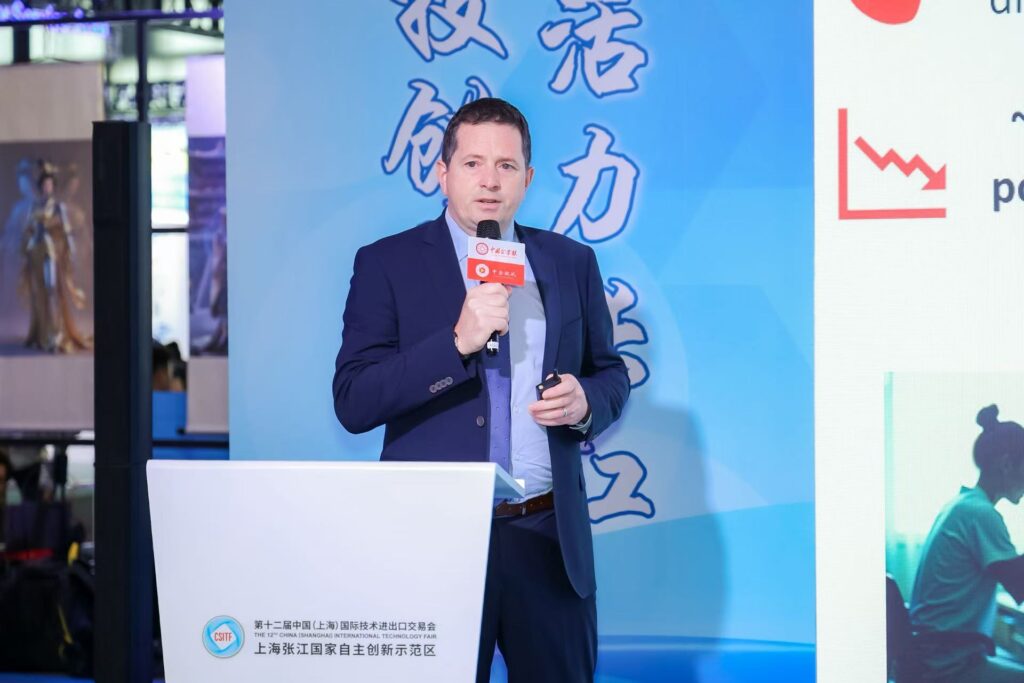
SMARTSHAPE members David Connolly and Ciarán Duffy recently travelled to China (Shanghai) International Technology Import and Export Fair. The project has gained international attention with also a feature in the leading Chinese business news Yicai Global, highlighting how European MedTech innovators are increasingly looking to China to accelerate commercialisation. The article follows the Irish delegation’s visit to China after the Ireland-China Medtech Innovation Summit, organised by Ireland’s National Medical Device Research Centre (CÚRAM).
The Chinese article can be found here:
An automatically generated English translation of the article can be found below:
Three Irish Teams Livestream at the China International Technology Fair:
Why Foreign MedTech and Pharma Startups Are Choosing China
Yicai Global (First Financial)
yesterday 22:24
Author: Cheng Fu Editor: Chen Shanshan
In May 2026, the inaugural Ireland–China Medtech Innovation Summit, organised by Irish and Chinese institutions including Ireland’s National Medical Device Research Centre (CÚRAM) and the Beijing Institute of Life Sciences, was held in Galway, Ireland. Three outstanding medical-device research teams selected at the summit were invited to China in June for a one-week study tour. They visited Beijing and Hainan to learn about China’s pharmaceutical and medical-device industries and later presented their projects via livestream at the China (Shanghai) International Technology Import and Export Fair (CSITF), marking the beginning of their efforts to use China as a base for commercialising their research.
On the opening morning of CSITF, Andrew Gallagher, project manager from the University of Galway, stood on the main stage in the “Technology Innovation, Dynamic Zhangjiang” exhibition area, preparing to introduce his team’s medical product through a live broadcast. The temperature in Shanghai exceeded 30°C. Although the exhibition hall was air-conditioned, Andrew, dressed in a suit, kept wiping sweat from his forehead. As more and more viewers joined the livestream, he seemed to feel a different kind of heat—the excitement of reaching a large audience.
Andrew’s first trip to China, and he found the combination of a trade-show presentation and livestream promotion quite novel. To ensure a smooth broadcast, the host repeatedly rehearsed the opening remarks. Since Andrew did not understand Chinese, he thought each rehearsal was the actual start and prepared to speak, only to realise it was still practice. Each time, his nervous expression relaxed, and he laughed while waiting for the next cue.
A Slow-Release Eye-Drop Technology
Andrew’s team brought an innovative microsphere formulation that can be added to ordinary eye drops. The microspheres slow the release of the medication, transforming it from an immediate-release to a sustained-release product. This allows the active ingredient to remain on the surface of the eye longer, improving efficacy while reducing how often patients need to use the drops. The formulation has already shown promise in conditions such as dry-eye disease and conjunctivitis.
Once the presentation began, Andrew confidently discussed the product’s mechanism, market prospects, and commercial plans. Afterward, event staff told him that more than 100,000 people had watched the livestream online. He widened his eyes in surprise and immediately asked where the replay would be available, saying he wanted to show colleagues back home how large the audience was.
For Chinese online events, an audience of 100,000 may be relatively ordinary. For Andrew, however—coming from a country of just over five million people—it was an impressive figure.
A Coffee Robot and China’s Manufacturing Potential
After his presentation, still struggling with jet lag and a dry throat, Andrew asked where he could find an iced coffee. Instead of taking him to a café, I brought him to a Chinese-made coffee robot. After scanning a QR code and placing an order on a phone, his iced latte arrived within two minutes.
At that moment, Andrew was less interested in the taste of the coffee than in what the collaborative robot represented. “When you’re serving a huge market—such as dry-eye patients in China—you have to think about scale. During this trip I’ve seen robots everywhere. Even buying coffee can be customised through a QR code. That’s the foundation for large-scale manufacturing and flexible production lines.”
China’s Integrated Supply Chain
Andrew’s commercial adviser, Patrick McDermott, has worked in ophthalmology for more than thirty years and had previously visited China several times. However, this was his first visit focused on exploring business opportunities and potentially expanding into China.
Within just one week, Patrick visited not only the Shanghai exhibition but also research institutes in Beijing and industrialisation projects in Sanya, Hainan.
“Everywhere I went in China, I saw a highly integrated industrial ecosystem. In Europe, supply chains are extremely fragmented. Research might happen in Ireland, production partly in Poland, and other activities elsewhere. In China, whether in Beijing or Hainan, all the upstream and downstream partners—from pilot production to large-scale commercialisation—can be found in one place. That level of integration is China’s advantage.”
China’s e-commerce infrastructure also left a strong impression on him.
“My overall feeling is that everything has been ‘Alibaba-ised.’ A Chinese partner showed me customised samples that could be delivered within a day, sometimes even half a day. That speed is astonishing and one of the reasons we’re so interested in China.”
At the same time, Patrick recognised that competition would be fierce.
“We’ll need to carefully review our strategy. Before this visit, we mainly thought about China’s market size and manufacturing costs. After seeing so much, we realise we need to think about how China fits into our global strategy and how we can build our own competitive advantages.”
Although their ophthalmology product is not expected to reach the market until around 2030, China has already become an essential part of their global commercialisation plans.
A Blood-Pressure Implant for Stroke Patients
Another livestream presenter was David Connolly, who leads a cardiovascular project at the University of Galway. Together with business-development colleague Ciaran Duffy, he is developing an implantable blood-pressure monitoring chip for hypertension patients. The technology enables continuous beat-by-beat blood-pressure monitoring without discomfort. Compared with existing products, its key advantages include eliminating measurement errors caused by skin tone and providing deeper haemodynamic data rather than just blood-pressure readings.
“For patients who have suffered one or more strokes, this could be extremely valuable. We’re talking about a global market potentially worth billions of dollars. In Europe, we have research, regulatory, and US-market partners. But when it comes to manufacturing and turning research into products, Ireland doesn’t have the same advantages. China does.”
According to David, speed is China’s defining advantage.
“China moves at a completely different pace from Ireland. It’s incredibly fast. That’s exactly why we’re here. Chinese partners not only have the capability but also a long-term vision. We don’t want to come here simply to take advantage of resources. We want mutual learning and shared growth. We already have partners in project management, regulation, and technology. China could become a major base in our globalisation strategy.”
From Nepal to Ireland: A GLP-1 Oral Drug Project
A third presenter was Sandeep Karki, originally from Nepal. He studied pharmacy in Pokhara, later moved to South Korea to study drug design and work in the field, and then relocated to Ireland for doctoral studies. His project focuses on developing an oral formulation of GLP-1, one of the hottest areas in the pharmaceutical industry today. Because of the enormous commercial potential of GLP-1 therapies, his project may have the broadest market prospects among those presented.
“Although I’m currently a student, I’ve worked in R&D and have started to get involved in commercial projects. During this trip to China, I’ve met many people who are successful in both science and business. I don’t yet know exactly what role I’ll play in the future, but perhaps one day I’ll find myself doing something I never imagined.”
Why China Is Attractive to European MedTech Startups
Yu Yue, a special host for the livestream event and a professional in the medical-device sector, noted that many European research institutions and startups are currently facing a difficult funding environment and manufacturing limitations, which have slowed commercialisation of new technologies. At the same time, China’s medical-device industry is shifting from a distribution-driven model to an innovation-driven one, creating strong demand for advanced technologies.
China’s advantages include:
- Concentrated manufacturing capabilities
- Highly integrated supply chains
- Strong ability to transform research into commercial products
- Rapid development in AI and big data
- A vast domestic market
These factors create significant opportunities for Irish startups and research groups seeking to commercialise their technologies.
Optimistic but Cautious
Despite recognising China’s manufacturing strength and cost advantages—which they described as difficult to replace globally—the Irish delegation admitted they knew relatively little about China’s national and regional industrial policies and healthcare reimbursement systems. Yet these issues are crucial for the medical-device industry and for research projects seeking successful commercialisation.
As Patrick put it:
“We need to find an effective roadmap.”
Fortunately, the teams have support from Ireland’s National Medical Device Research Centre and access to a broad professional network, giving them some resilience against risk.
The article concludes by observing that while Chinese companies increasingly talk about “going global,” foreign startups entering China face many of the same opportunities and challenges.
Author’s note: The author has worked in multinational pharmaceutical companies for twenty years, focusing on innovation and intelligent manufacturing.


